 EN

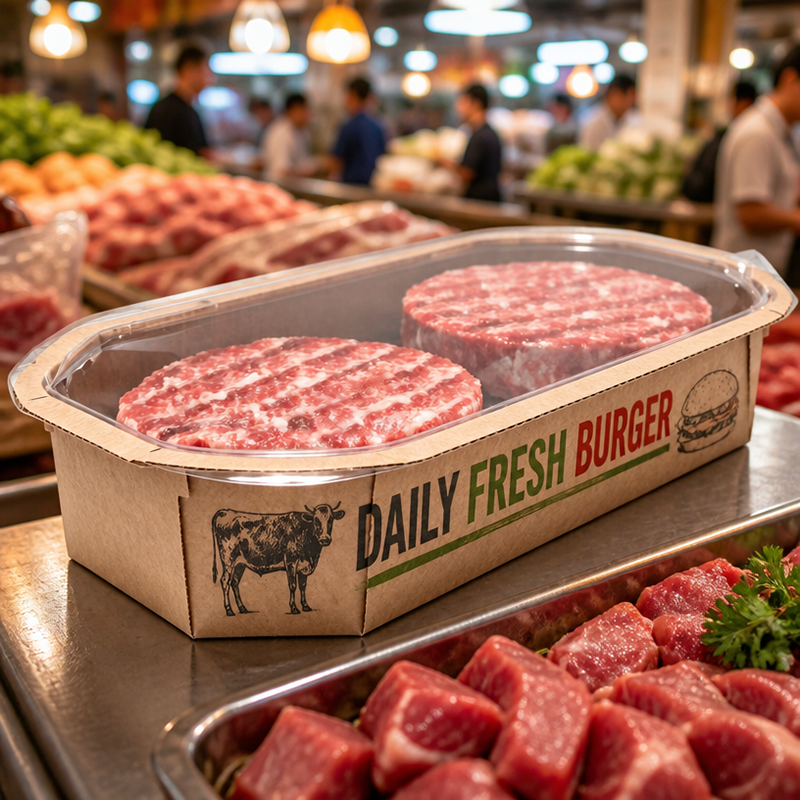
With growing demand for sustainable packaging upgrade, meat, seafood and ready-meal manufacturers are phasing out conventional plastic trays for paper-based MAP trays. Modified Atmosphere Packaging replaces inner air with calibrated protective gas mixture to slow microbial growth and extend chilled shelf-life. It fits automated sealing production, supermarket retail display and brand-image enhancement.
Paper-based freshness-lock trays are composed of paperboard substrate plus functional barrier layers. Matched with corresponding lidding film, they deliver structural rigidity from paperboard together with gas-barrier performance for fully-automatic high-speed tray-sealing production. When selecting trays, enterprises shall comprehensively consider food category, loading weight, existing packaging machinery and local end-of-waste regulations.
MAP Working Principle & Application Scenarios
MAP displaces air inside trays with mixed protective gas to retard food oxidation and suppress bacterial reproduction. Under 4°C refrigeration, MAP-packed meat can reach up to 14-day shelf-life for mass industrial production.
Paper-based MAP tray main applications:
* Fresh meat: pork, beef, poultry
* Seafood: fish, shrimp and other marine‑sourced ingredients
* Chilled ready-to-cook meals & ready-to-eat deli
* Selected fruit-vegetable items and chilled light-food bento boxes
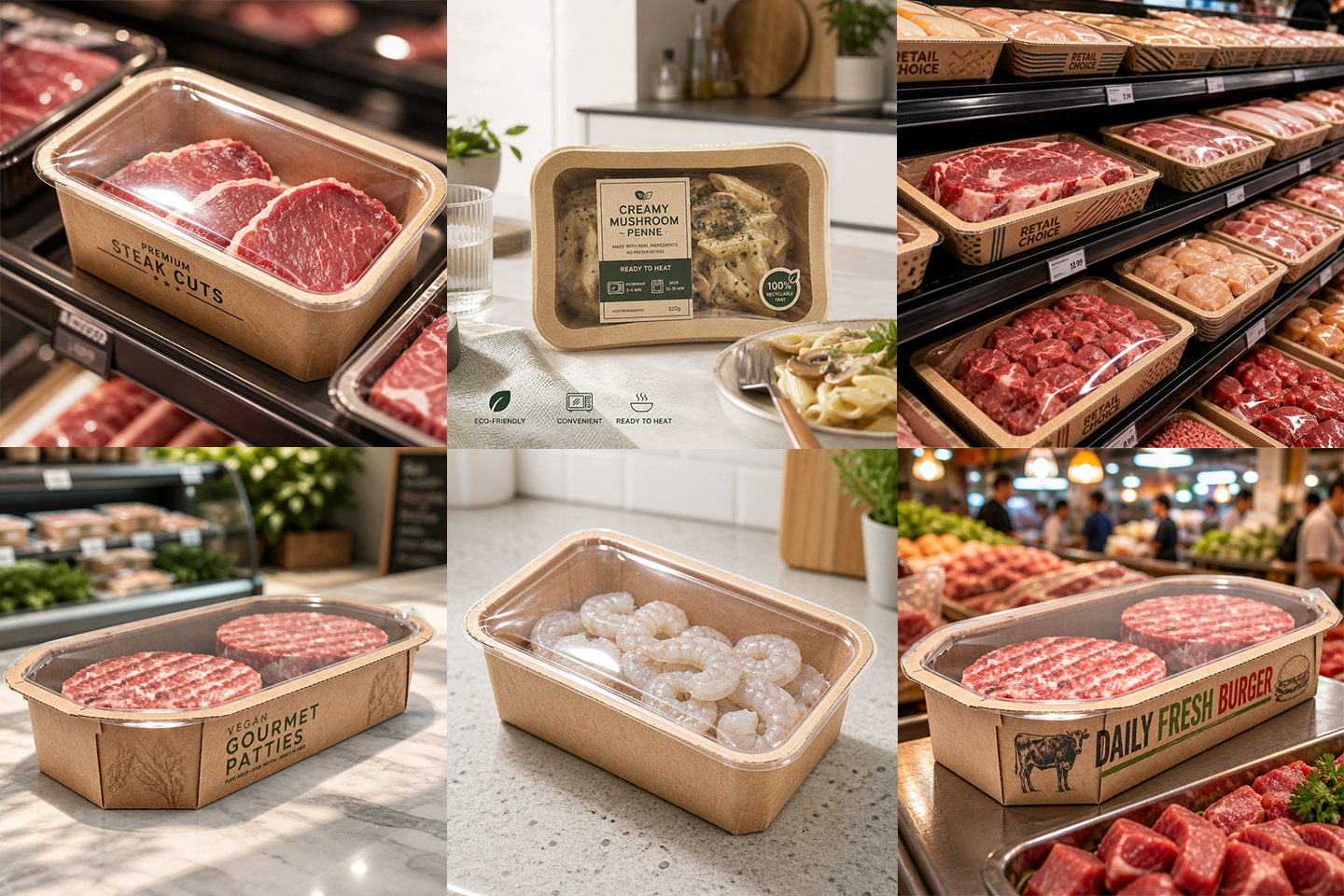
We supply two formats of paper-based MAP trays: rectangular and octagonal.
(1) Rectangular MAP Paper-Based Tray Standard geometry for pork, beef, minced meat, poultry and prepared food. Good stacking stability for continuous high-volume sealing production. Supports printing of brand, origin and cooking instructions, widely adopted by food processors and supermarket supply chains.
(2) Octagonal MAP Paper-Based Tray Differentiated appearance for stronger shelf-standout effect. Custom size, grammage and printing patterns available, ideal for retail brands pursuing unique packaging identity.
Two Barrier-Layer Structires: Extrusion-Coated vs Peelable-Laminated Paper-Based Trays
The barrier layer determines the airtightness and water resistance of the tray, and directly affects later recycling and disposal. It is divided into two types: co-extruded film integration and peelable laminated film.
Comparison Item |
Extrusion-Coated Paper-Based MAP Tray |
Peelable-Laminated Paper-Based MAP Tray |
Structure |
Barrier layer directly extruded onto paperboard; monolithic construction |
Barrier film compounded onto paperboard; peel-off separable |
Separability |
Non-peelable |
Peel-off separable |
Performance |
Suitable for items requiring short shelf‑life; cannot realize full air barrier |
Suitable for long-term storage & frozen goods; zero air penetration |
Ideal Application |
Stable sealing integrity & high-speed continuous production |
Projects requiring material separation & local waste-sorting compliance |
Verification Points |
Material formulation, sealing performance, dimension, recycling scheme |
Film grade, peel-off performance, lamination process |
Neither structure is universally superior. Make selection based on production-line throughput, required shelf-life, frozen-storage requirement and waste-management legislation in sales territories.
MAP vs VSP Vacuum Skin-Packaging Comparison
Dimension |
MAP Modified-Atmosphere Tray |
VSP Vacuum Skin Packaging |
Freshness Principle |
Replace ambient air with mixed protective gas for microbial inhibition |
Vacuum negative pressure; film clings to food for physical barrier |
Core Strength |
Longer chilled shelf-life, suitable for mass-volume production |
Fully expose food texture & color for premium retail value |
4°C Chilled Shelf-Life |
Up to 14 days |
Up to 7 days |
Primary Use Cases |
Fresh meat, seafood, ready-to-cook food |
Steaks, thinly-sliced fresh meat, frozen deli |
Visual Display |
Basic product visibility |
Full texture exposure with premium retail look |
Prioritize MAP for long shelf-life and large-batch processing. Select VSP for premium steak / thin-cut meat focusing on shelf-presentation and added value.
Critical Check: Compatibility With Your Existing Machinery
Equipment compatibility is top concern for manufacturers switching packaging materials. Many factories worry that adopting paper-based trays requires complete machine replacement and new mould investment.
Paper-based MAP trays can match existing tray-sealer specifications via sample trials. Confirm below information in early-stage project assessment:
1. Tray-sealing machine brand & model
2. Tray outer geometry, length × width × depth, single-tray load capacity
3. Mould positioning method and compatible lidding-film heat-seal layer
4. Heat-sealing temperature, pressure, cycle speed and continuous-production requirement
We provide physical samples for filling, sealing, stacking & transportation tests. For peelable-laminated versions, validate peel-off performance. Optimize tray construction and sealing parameters based on trial feedback to reduce packaging-switch-over cost.
Complete Project Implementation Workflow
Requirement Evaluation: Confirm food category, loading weight, tray dimension, machine model, lidding-film and target sales market.
1. Structure & Material Selection: Choose rectangular / octagonal shape; select extrusion-coated or peelable-laminated barrier solution; confirm printing and accessory requirements.
2. Sampling & Machine Trial: Run filling, sealing, drop-test and stacking test with physical samples; verify peel-off property for laminated type.
3. Documentation Support: Supply food-contact compliance reports, material certificates and waste-classification guidance.
4. Mass Production & Delivery: Mass manufacturing upon sample confirmation for packaging-solution roll-out.
If you are assessing paper-based MAP or VSP tray options, feel free to contact us for samples and technical consultation. Visit our product page for full details of paper-based MAP & VSP trays.