 EN
EN

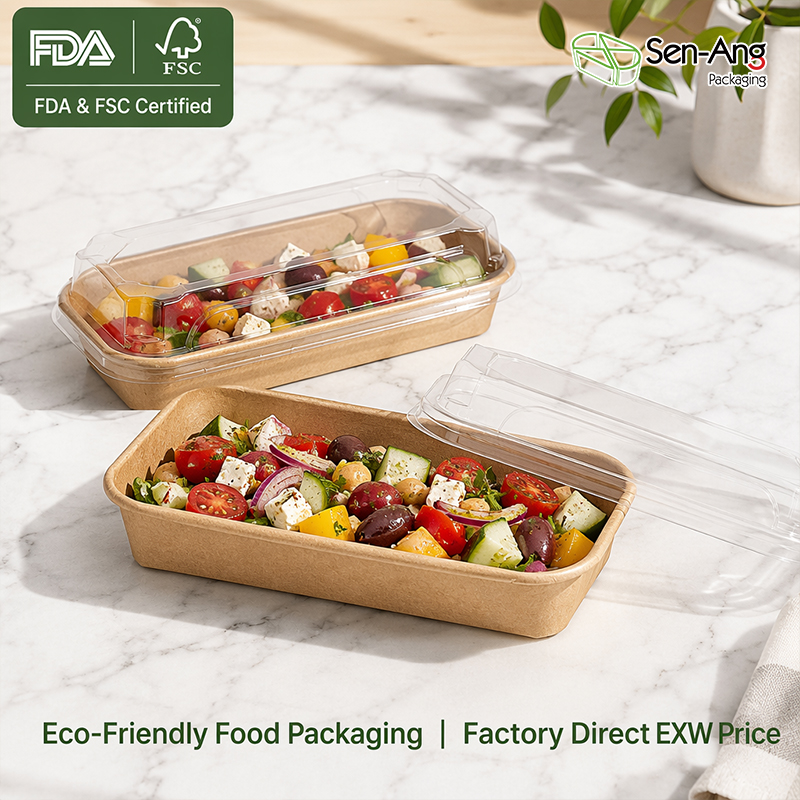
Most packaging decisions are made on the unit price, and most of them are wrong. A tray that costs less per piece can still cost more per order once labour, storage, waste fees and compliance exposure are counted. Paper trays change that calculation because they remove work from the kitchen instead of adding it: no washing, no return logistics, less shelf space, and one disposal route the customer already understands.
This guide sets out the business case in the order an operator actually evaluates it — cost, operations, compliance and brand — and ends with the questions worth asking a supplier before the first order.

The Financial Case
Cost per Order, Not Cost per Unit
Paper trays look more expensive than reusable dishes on the invoice and cheaper once the whole process is counted. Reusable service ware carries washing, drying, storage, breakage, replacement and staff time; paper trays carry purchase and disposal. For a site serving a few hundred covers a day, the labour line usually decides the comparison on its own.
Volume then moves the unit price. Ordering paper trays in container quantities and standardising on two or three sizes reduces both the piece price and the number of SKUs the kitchen has to manage. Custom print adds setup, but it is paid once per run, not per tray.
Waste Fees and Compliance Exposure
Waste is a cost line that changes with local rules. Where organic waste is priced separately, a paper tray that can go into the food waste stream may cost less to dispose of than a plastic container that cannot. Where plastic restrictions are tightening, paper trays remove the risk of a forced packaging change mid-contract — the kind of switch that consumes management time and disrupts supply for a quarter.
Compostable paper trays only deliver that benefit if the destination actually accepts them. Many industrial composting facilities reject coated or food-soiled material, so the honest version of the claim is narrower than the marketing suggests. Operators should check the receiving facility before printing a compostability message on the lid.
| Decision factor | Reusable service ware | Paper trays |
|---|---|---|
| Up-front cost | High per item, long service life | Low per item, consumed per order |
| Labour | Washing, drying, stacking, breakage | Assembly only |
| Storage | Volume of clean and dirty ware | Flat-packed, nests tightly |
| End of life | Wash and reuse, eventual replacement | Recycle, compost or general waste by site |
Operations
Storage, Speed and Service Flow
Space is the constraint most kitchens under-estimate. Flat-packed paper trays stack in a fraction of the volume that clean dishes occupy, which frees shelving near the pass and shortens the walk between storage and plating. A pre-creased tray assembles in one movement, so a new hire can be taught in minutes rather than shifts.
They also remove the return leg of the journey. Nothing comes back to be washed, counted or chased, which simplifies closing and removes a common source of friction between front and back of house.
Matching the Tray to the Menu
Most complaints blamed on the kitchen are really specification failures. A greasy item needs a grease-resistant barrier; a hot, covered item needs a vent path so steam escapes; a sauced dish needs a seam that is glued rather than folded. The right paper trays are available in all three configurations, but only if the buyer states the menu and holding time instead of ordering by size alone.
Depth matters as much as footprint. A wide, shallow tray presents a portion well but flexes under weight, while a deeper format carries load down its walls. The right answer comes from the actual dish and the actual delivery time, not from a catalogue photograph.
Compliance and Documentation
Plastic Bans and Food Contact
Single-use plastic rules now differ by country, region and sometimes municipality, which makes packaging a moving compliance target. Paper trays sit on the compliant side of most of those rules, provided the coating and ink are suitable for food contact and the claim printed on the tray can be supported.
Food contact is where buyers should slow down. Board, barrier, adhesive and ink all touch the food or sit close enough to migrate into it. Ask for documentation that matches the actual material and the actual use, not a generic paper certificate.
Certificates That Carry Weight
Certification is only useful if it names the product. Compostability certificates usually apply to a specific material under specific conditions, and food-contact reports usually apply to a specific construction. A supplier that can map each certificate to the SKU being ordered is easier to audit than one that sends a folder of logos.
Brand and Customer Experience
Why Paper Trays Photograph Well
Paper trays have a matte surface and a natural tone that flatters food in daylight, which is why they appear so often in delivery photography. Print sits cleanly on the board, so a logo or a short campaign line reads at arm's length without a label. That is brand exposure on a surface the customer handles for the length of the meal.
Convenience Expectations
Customers judge takeaway packaging on three things: whether it leaks, whether it opens easily, and whether they feel bad throwing it away. A paper tray answers the third question more convincingly than foam or rigid plastic, and the first two are settled by the barrier and the rim design. Getting those right protects the review score more than any design flourish.
Procurement Checklist
What to Ask Before Ordering
Ask for the board weight, the barrier type, the coating on both faces, the seam construction and a filled sample tested at service temperature. Confirm the carton count, the pallet configuration and the lead time for a repeat order, not just the first one. Then ask which certificates cover the exact SKU.
Finally, check production capacity against your peak. A supplier running automated forming at a daily output in the hundreds of thousands of pieces can absorb a seasonal spike; a small converter cannot, and the shortfall usually appears in your busiest month. Custom printed paper trays can ship in as little as three days when artwork is approved early, which is worth knowing before a launch date is fixed.
FAQ
Are paper trays suitable for all food service operations?
For most, yes, but the specification has to match the menu. Greasy and high-moisture dishes need a proper barrier and often a vent; dry items need far less. Operations with heavy dine-in volumes may still prefer reusable ware for the dining room and paper trays for takeaway.
How do paper trays compare in cost with plastic?
Piece prices are usually close, and paper often wins on total cost once disposal, compliance risk and labour are counted. Plastic keeps an advantage in very long holding times and extreme moisture, which is exactly where paper trays need the right coating to compete.
Do paper trays hold temperature well?
They insulate adequately for a normal delivery window, but they are not insulated containers. For long routes, pair paper trays with a bag or a lidded format and keep hot and cold items separate. Temperature performance is a system question, not a tray question.
What happens to paper trays after use?
Clean, uncoated trays can usually be recycled with paper. Food-soiled or heavily coated trays normally go to general waste or commercial composting where the facility accepts them. The practical route depends on the local infrastructure, so the disposal message on the packaging should match what the site can actually do.
The case for paper trays is not that paper is inherently greener. It is that paper trays remove washing, cut storage, simplify compliance and put the brand in the customer's hands — four commercial benefits that happen to arrive with a better end-of-life story.